
So, Hnefatafl, then.
Sometimes referred to as Viking chess, Hnefatafl was once popular throughout all of northern Europe up until its popularity was eventually usurped by chess with its hierarchy of pieces appealling to the medieval mind (and who doesn't love the horsies). Boards and written records have been found all over from the Balinderry Board to the laws of Hywel Dda. I am told the name translates to King's Table, and it is actually the basis for the Discworld spin-off game Thud. It is also the head of a family of games known at Tafl games. The board looks like this...
 |
| Hnefatafl |
The first thing you will notice, unless you're odd, is that the opposing sides are not opposite; instead the white pieces are ensconsed within a threatening ring of red pieces. The second thing you note is that the white pieces are vastly outnumbered, to the tune of two to one. Lastly you will probably note that the central white piece is different to the others. This is the only king on the board. All these features are common to, and define all Tafl games.
 |
| Corner Square, the Holy Grail |
The rules of all Tafl games are remarkably similar as well, so by outlining the rules of Hnefatafl you will have the basics of all them. The aim of the game is different for both players, the white defender is trying to allow the King an escape, vikings clearly believing discresion to be the better part of valour. The red attackers are trying to stop him, as simple as that. All the pieces, without exception, move as rooks in chess. That is to say in a straight line orthogonally any number of squares as long as nothing blocks their path. They cannot pass through the centre square whether it is occupied or not. The king escapes by landing on any of the four corner squares, which red pieces are not allowed to enter. Pieces are taken as in Latrunculi, that is one piece must be surrounded on two sides orthogonally by opposing pieces. Unlike Latrunculi, however, the king must be surrounded on four sides, or on three sides with a board edge/centre square blocking the fourth side.
Sound straightforward? Simple? Oh, dear. That's what I thought at first, too. But I took a copy of a Tafl game, Tawlbwrdd, to an event recently and actually got a chance to play! Rather than setting things up for the public to play.
Sound straightforward? Simple? Oh, dear. That's what I thought at first, too. But I took a copy of a Tafl game, Tawlbwrdd, to an event recently and actually got a chance to play! Rather than setting things up for the public to play.
My Tawlbwrdd game.
Tawlbwrdd is one of two Welsh tafl games and the only one thought to be unique to Wales. It is mentioned in the Laws of Hywel Dda in the tenth century as a job perk for Judges and mention crops up again and again until the thirteenth. It is one of the a larger member of the tafl family, although not perhaps as big as Alea Evangelii or Large Hnefatafl. It has four more defenders and eight more attackers to maintain the ratio and is played on an 11x11 board, because the board is bigger you only need to get the king to any edge square to win. From the games I played on the day I noticed that this does give white a distinct advantage.
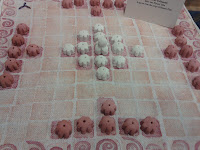 In the three games I played on the day I played white only once and won only two out of the three games, once as red. The game above led to me having my backside handed to me by a member of another Re-enacting group, as she managed whether by luck and flaw or design to set up the equivalent of a rolling mill where I blocked the king, she took my piece, I moved a piece up, she opened a path for the king to the edge, I blocked the king, she took my piece, I moved a piece up, she opened a path for the king, I blocked the king and essentially kept this up with very little variation until I eventually ran out of pieces. It was like playing against a mincing machine. This could not have happened anywhere near as easily if she had to get the king to a corner. But thats war and Tafl and I even enjoyed being beaten, it has given me a tactic to try when I am next playing white.
The board construction is covered here. The construction of the pieces was easy although not too tidy to begin with. I simply used a floreat cutter, but in order to give a more pawny (is that a word? Should be) quality rolled a ball of clay and cut into that. It did take quite a few attempts to get right and the finished articles are a bit rough and ready but I quite like the whole look of cheap, cobbled together pieces, I feel they are more authentic for a peasant like me. And the abstract designs match some of those of the medieval and earlier periods as on display at Jon Crumiller's page.
 |
| That all important first move. |
 In the three games I played on the day I played white only once and won only two out of the three games, once as red. The game above led to me having my backside handed to me by a member of another Re-enacting group, as she managed whether by luck and flaw or design to set up the equivalent of a rolling mill where I blocked the king, she took my piece, I moved a piece up, she opened a path for the king to the edge, I blocked the king, she took my piece, I moved a piece up, she opened a path for the king, I blocked the king and essentially kept this up with very little variation until I eventually ran out of pieces. It was like playing against a mincing machine. This could not have happened anywhere near as easily if she had to get the king to a corner. But thats war and Tafl and I even enjoyed being beaten, it has given me a tactic to try when I am next playing white.
 |
| Swedes! |


