Showing posts with label Ludus Latrunculorum. Show all posts

Sunday, May 20, 2012

Rough Draughts

Trying to be authentic can be a pain in the jacksie, especially when trying to carve your own furrow in living history. As far as I am aware I am the only re-creationist who specialises in board games. I'm almost certainly the only recreationist who specialises in early 14C British ludology. Consequently I have to, if not discover the information, certainly compile it for the first time. And that to meet the rigorous standards of authenticity of Samhain.
Sometimes I think it might be nice to not be tied to a specific geography or time period. For example, I cannot have playing cards, for although they have appeared on the continent by now, there is no reference to them in Britain until after Chaucer. There are some other interesting games like Glückhaus or Bocce which never made it to these islands at all.  But then why worry? When there are plenty of games out there which everyone knows were here in medieval times. Lets take a case in point, the authentically medieval game of Draughts.

Can anyone feel a draught?

Draughts is as old as the hills, everyone knows that. It's listed in finds from Ancient Egypt. Many of the books I refer to regularly for my games say it was played in Ancient Egypt and boards and pieces have been found that seem to bear this out. There are images of it being played in medieval manuscripts. We hear tell of "checkers" in contemporary accounts. It is listed and sold as a medieval game by people who make for the living history trade. So where's the problem? Well, in our house we call it Pennant's Disease.

Pennant's Disease

Tommy P. 18C Babe-magnet.
Thomas Pennant (1726-1798) was a naturalist antiquary from our neck of the woods, and in the course of things wrote a number of books including a couple of volumes called Tours in Wales. Although we name it for him, it could in truth be called Antiquary's Disease, Morganwg Disease or perhaps in a more modern idiom, Wiki-disease.
Now I'm sure that Thomas was a decent sort, did his best at school, brushed his teeth regularly and all that, but whether by misunderstanding, misprint, or deliberate colouring of details for artistic purposes, errors were bound to creep into his works.Well this is unfortunate, you may say but completely understandable, what's it got to do with the price of fish? Well what if the price was never corrected, and after a hundred years or so no-one could remember fish being any other price, and Pennant's Fish Index was taken as the Gospel truth it never was? Piscine chaos.

A Healthy Draught
Authentic Medieval Draughts
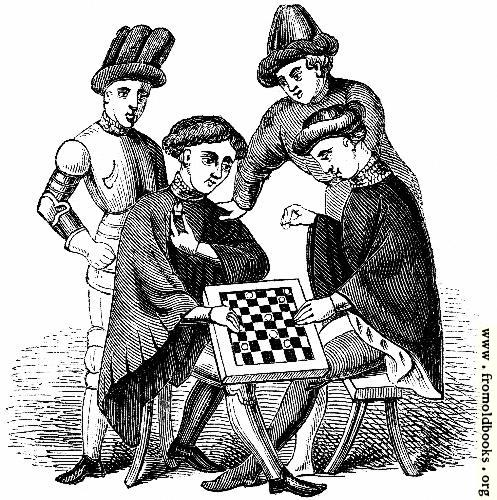
But draughts is medieval, surely? Everyone knows it is, don't they? There is, after all pictorial evidence like the picture on the right. The image comes from a book called Old England: A Pictorial Museum (1845) (made available thanks to fromoldbooks.org) and is a reproduction of an image from a medieval manuscript, in the book it is even listed as 1145 - Playing at Draughts so that should be conclusive shouldn't it? The pieces are all circular counters and placed only on white squares. However, to take this image on face value is pure Pennant's Disease, and the thought of having our society's fact-checker hovering over your shoulder is enough to turn any one into a right suspicious bastard.
So when presented with these 19thC reproductions I have to ask myself some serious questions such as; If this is draughts, why are the pieces all the same colour? And why is the figure sitting on the left holding a different style of playing piece in his hand?
We are more fortunate these days in that we are, thanks to the Internet, able to trace primary sources more easily than ever. The libraries of the world have gotten tired of us the grubby public running our dirty, acidic fingers over their precious manuscripts, breathing our damp breath on the pages and exposing them to the fading daylight. Their answer has been to put most of their archives online this includes the manuscript from which this picture was copied. The source is given as Harleian 4431 which has been digitised by the British Library, the appropriate page is here, and below is the image of the illuminated page.
Authentic Medieval Dr- what the ...?
The one thing that is immediately obvious is that this is no game of draughts, the listing by the British Library even says Ulysses Playing Chess. And this is what I discover when I chase up any references to medieval draughts, it's another game such as chess or chequers [a gambling games where coins are flipped onto a chequerboard and bets are placed on black or white, like roulette without David Niven. This is not, Not checkers, which is confusingly, the name for Draughts in America and some other countries. Hello, America, by the way, you have a nice day, now.] 

The Naming of the Animals
Adam and Eve are walking in the garden of Eden and Eve sees an animal and asks Adam, "What's that?" (a tradition kept up by women today during films). "It's a Rhinoceros" says Adam, smugly, probably scratching himself inappropriately. "How d'you know it's called a Rhinoceros?" ask Eve, beginning another tradition of questioning everything a man says. Adam thinks for a minute (this did not catch on) and says "Well, it looks like a Rhinoceros, doesn't it?"

So with this break in the draughts fossil record, what are we to make of the Egyptian boards and pieces? These boards are almost never 8x8 chequerboards with 12 pieces a side as chequers. Archaeologists are not often Ludologists as well. It looks like a thing I know, so it is that thing. This kind of misnomer happens across the board from American Buffaloes (really a Bison) to Lutes (cittern, citole, lyre, etc.) and can, as in the case of the American Buffalo become the actual name for the thing. Had the Archaeologists been familiar with the game Latrunculi which was played in Ancient Rome and Greece (contemporaries to Egypt) with a similar layout.

Last Nail in the Coffin?

Strutt, in Sports and Pasttimes of the People of England who is not bad, as authorities go, describes draughts as a modern game although popular and widespread when writing in th early 19thC.
So is that the end of draughts as a medieval game? Perhaps not, but it does look doubtful based on any evidence that I can find. No-one seems to truly know what the origins of this game are and absence of evidence is not evidence of absence, so there is still hope I will turn a page one day and find something irrefutable.

Am I, then, advocating that all medieval reenactors who have beautiful, hand-made wooden draughts sets shouldn't use them? Of course not, something may yet come to light that removes all doubt as to the game's provenance, but what I am saying is until it does it will not pass the authenticity litmus test of Samhain. That should not detract, however, the simple elegance of what is a real classic. .

Tuesday, February 21, 2012

King's Table

We have now arrived at the point where my makes have overtaken my blog posts but I'm just going to witter on until things even out again.
So, Hnefatafl then.
     Sometimes referred to as Viking chess, Hnefatafl was once popular throughout all of northern Europe up until its popularity was eventually usurped by chess with its hierarchy of pieces appealling to the medieval mind (and who doesn't love the horsies). Boards and written records have been found all over from the Balinderry Board to the laws of Hywel Dda. I am told the name translates to King's Table, and it is actually the basis for the Discworld spin-off game Thud. It is also the head of a family of games known at Tafl games. The board looks like this...
Hnefatafl
The first thing you will notice, unless you're odd, is that the opposing sides are not opposite; instead the white pieces are ensconsed within a threatening ring of red pieces. The second thing you note is that the white pieces are vastly outnumbered, to the tune of two to one. Lastly you will probably note that the central white piece is different to the others. This is the only king on the board. All these features are common to, and define all Tafl games. 

Corner Square,
the Holy Grail
The rules of all Tafl games are remarkably similar as well, so by outlining the rules of Hnefatafl you will have the basics of all them. The aim of the game is different for both players, the white defender is trying to allow the King an escape, vikings clearly believing discresion to be the better part of valour. The red attackers are trying to stop him, as simple as that. All the pieces, without exception, move as rooks in chess. That is to say in a straight line orthogonally any number of squares as long as nothing blocks their path. They cannot pass through the centre square whether it is occupied or not. The king escapes by landing on any of the four corner squares, which red pieces are not allowed to enter. Pieces are taken as in Latrunculi, that is one piece must be surrounded on two sides orthogonally by opposing pieces. Unlike Latrunculi, however, the king must be surrounded on four sides, or on three sides with a board edge/centre square blocking the fourth side.

Sound straightforward? Simple? Oh, dear. That's what I thought at first, too. But I took a copy of a Tafl game, Tawlbwrdd, to an event recently and actually got a chance to play! Rather than setting things up for the public to play.

My Tawlbwrdd game.
That all important first move.
Tawlbwrdd is one of two Welsh tafl games and the only one thought to be unique to Wales. It is mentioned in the Laws of Hywel Dda in the tenth century as a job perk for Judges and mention crops up again and again until the thirteenth. It is one of the a larger member of the tafl family, although not perhaps as big as Alea Evangelii or Large Hnefatafl. It has four more defenders and eight more attackers to maintain the ratio and is played on an 11x11 board, because the board is bigger you only need to get the king to any edge square to win. From the games I played on the day I noticed that this does give white a distinct advantage.

In the three games I played on the day I played white only once and won only two out of the three games, once as red. The game above led to me having my backside handed to me by a member of another Re-enacting group, as she managed whether by luck and flaw or design to set up the equivalent of a rolling mill where I blocked the king, she took my piece, I moved a piece up, she opened a path for the king to the edge, I blocked the king, she took my piece, I moved a piece up, she opened a path for the king, I blocked the king and essentially kept this up with very little variation until I eventually ran out of pieces. It was like playing against a mincing machine. This could not have happened anywhere near as easily if she had to get the king to a corner. But thats war and Tafl and I even enjoyed being beaten, it has given me a tactic to try when I am next playing white.

Swedes!
The board construction is covered here. The construction of the pieces was easy although not too tidy to begin with. I simply used a floreat cutter, but in order to give a more pawny (is that a word? Should be) quality rolled a ball of clay and cut into that. It did take quite a few attempts to get right and the finished articles are a bit rough and ready but I quite like the whole look of cheap, cobbled together pieces, I feel they are more authentic for a peasant like me. And the abstract designs match some of those of the medieval and earlier periods as on display at Jon Crumiller's page.

Tuesday, January 24, 2012

Ludicrous and Truculent

This make is of a Roman game. I hear there here are some accounts of this game being played in Scandinavia in the middle ages and if ever I find them I will link them here. For now take that with a pinch of salt. What is certainly true is that there is a lot to be recognised in this game, the equal sided opposition of chess, the lack of heirarchy of the playing pieces as in draughts and the capturing method of the tafl games. The game is Ludus Latrunculorum,  or Latrunculi or Latrones, which means the Game of Brigands, or Bandits or Mercanaries or Soldiers.

Not a chess board.

When it came to making the game I already had the board! I covered this in a previous article (Article! He calls it an article now!) I picked up some Fymo cutters and some self drying clay, and cut out some simple shapes I think are called floreats out of the clay, eight of each to give a complete rank (Beg pardon? You heard.).
Floreat Cambrensis
 They didn't look quite right but I found a dot on each petal added something. 

Shall we play a game?

Latrunculi is a reconstructed game, in other words one which no-one genuinely knows how it was played. However we are not entirely clueless. Cleverer people than I, who call themselves ludologists, have studied long and hard using contemporary records, similar games,  two yoghurt pots and some sticky-backed plastic to produce what are to believed to be a fairly accurate approximation of the rules. Unfortunately ludologists tend to be academics and there is no money in amity, so there are several different versions of the rules, all of which are truly authentic and accurate; for a given value of authentic, accurate and true.
Ranks assembled
So from the literature there are several possible set ups. There are 7x8 boards, 8x8 with 8, 9, 13 and 16 pieces. As you can see I've gone here for an 8x8 board for convenience sake (it's handy to have a board that can be used for several games), and an eight-a-side set with an additional, smaller "Duke" on each side. There are also differences of opinions as regards some of the rules but there are a few things that all versions agree on is the movement of the pieces. All the pieces, regardless of rank, move in straight, orthogonal lines as far as the player wishes without passing over any other pieces (friend or foe); just like a rook in chess. But you do not take your opponent's pieces by simply moving into a square occupied by them (which would make for a game shorter than my attention sp- ooh, look! A squirrel!). Rather a single opponent's piece has to be surrounded on two sides (horizontal or vertical) to be taken .
Variants include;
  • the Duke cannot be taken (so will be the last piece on the board) 
  • the Duke can jump over a single opponent's piece as part of it's move
  • the pieces can only move one square at a time (slooooooooooowww)
  • at the begining of the the game the players take turns placing their pieces anywhere on the board (why not just play morris?)
  • roll a dice each turn to determine how far a piece can move (WTF?)
The game ends when one side has been reduced to one piece (so cannot take), or a player cannot make a legitimate move or 30 moves have been made without a piece being taken.

In conclusion then this looks like a really nice little game, with a couple of variants should lift it a bit although others I could happily leave behind (you'll never guess which).

If you have been effected by anything in tonight's blog...

Latrunculi at Cyningstan with a downloadable pdf leaflet. The wonderfully knowledgable Damien Walker.
The Game Cabinet although this has not been updated in over ten years the site still seems to be up (for now). Scroll down to the bottom for Latrunculi.
Roman Board Games a nice little site that does what it says on the tin.